
In a recent webinar we held with Deloitte, we explored a question many organizations are now confronting: why do total rewards remain materially expensive and operationally complex, yet still feel underwhelming to the workforce they are meant to serve?
For years, total rewards lived in an uncomfortable middle ground. Leaders invested heavily. Programs expanded. Technology proliferated. And yet employees often described the experience with a single word: meh.
Deloitte’s 2018 High Impact Rewards research made that disconnect visible. Value was being delivered, but not felt. Rewards existed as policies and programs, rarely as a cohesive experience tied to performance, culture, or strategy.
Fast forward to 2024, and Deloitte’s updated research tells a different story. Not because organizations discovered better perks, but because the most successful companies fundamentally changed how they think about rewards. They stopped managing them as a collection of initiatives and started operating them as a system.
This shift—from transactional execution to intentional design—is what Deloitte now defines as Total Rewards maturity.
→Access the full 2025 report by Deloitte here ←
The most important takeaway from Deloitte’s research is not about recognition, benefits, or incentives in isolation. It is about organizational capability.
High maturity organizations are not simply more generous. They are more disciplined.
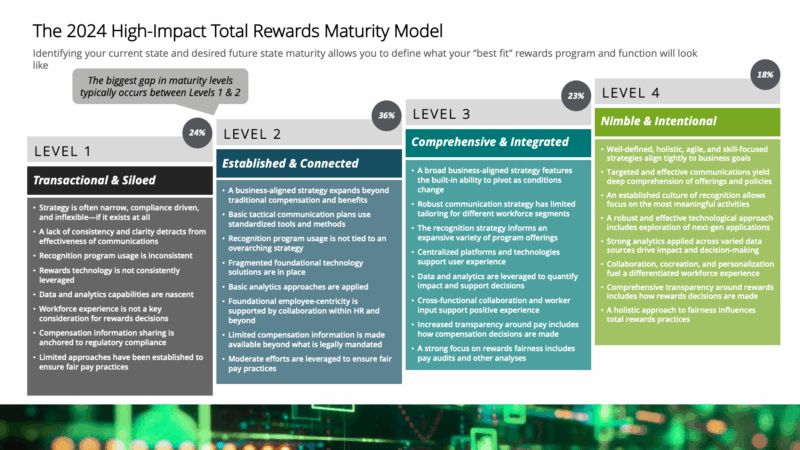
Deloitte’s data shows that high maturity organizations are:
This is not correlation without context. Deloitte explicitly tested rewards practices against business outcomes and validated the relationship.
At the board level, this reframes total rewards from a cost discussion into a performance system discussion.
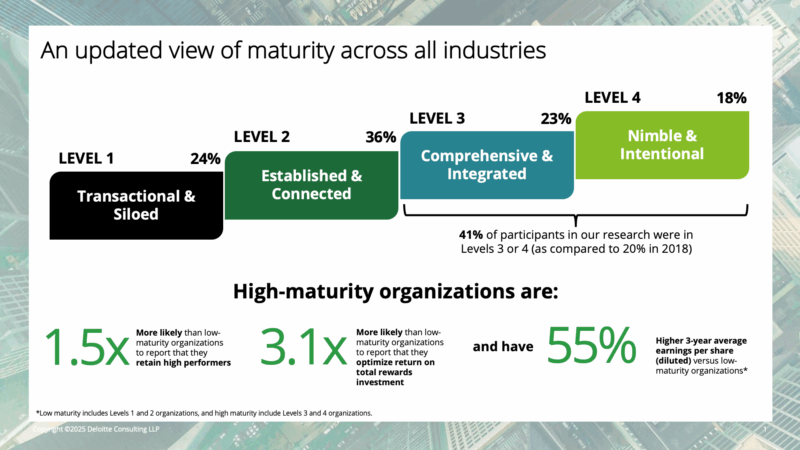
Deloitte’s maturity model defines four distinct organizational states.
Level 1: Transactional and Siloed
Rewards are compliance-driven and fragmented. Recognition is inconsistent. Technology is underutilized. Data is minimal. Workforce experience is largely an afterthought.
Level 2: Established and Connected
Basic alignment emerges. Communication improves, but remains standardized. Recognition exists, but without a unifying strategy. Foundational technology and analytics are in place, though still fragmented.
Level 3: Comprehensive and Integrated
Rewards strategy aligns tightly with business objectives. Recognition informs a broad set of programs. Centralized platforms support the employee experience. Data is actively used to guide decisions. Transparency and fairness become visible priorities.
Level 4: Nimble and Intentional
Rewards operate as a fully integrated business system. Communication is targeted and personalized. Recognition is cultural rather than programmatic. Advanced analytics drive decisions. Collaboration and workforce input shape experience design. Transparency and fairness are embedded across total rewards.
The most significant maturity gap consistently occurs between Levels 1 and 2. Many organizations invest heavily but never cross the threshold where rewards stop being administered and start being designed.
According to Michael Gilmartin, Deloitte’s research lead, the pandemic was the inflection point.
Organizations were forced to confront a simple question: how are we actually showing up for our workforce during disruption?
This exposed three structural shifts.
The end of information asymmetry
Employees no longer passively accept whatever benefits information is pushed at them. If organizations do not communicate clearly and proactively, employees will seek answers elsewhere. High-maturity organizations consolidate, personalize, and contextualize rewards information so employees understand both the value and the intent.
Recognition emerged as a maturity driver.
In 2018, recognition was not a defining factor of maturity. By 2024, visibility, frequency, and authenticity of recognition clearly differentiated high-maturity organizations. Recognition moved beyond tenure milestones into daily, team-based, and peer-driven acknowledgment tied to business outcomes.
Total rewards became inseparable from strategy.
High-maturity organizations no longer design rewards independently of business objectives. Total rewards strategy and organizational strategy move in tandem, enabling agility during both internal and external disruptions.
One of the most consistent misconceptions Deloitte’s research dismantles is the idea that maturity comes from adding more programs.
It does not.
High-maturity organizations do not chase trends. They invest intentionally where differentiation matters most for their workforce and business model.
They sense employee needs continuously rather than annually. They act on that data. And they adjust.
This is why maturity is not linear and why no checklist exists. Organizations can be advanced in recognition and underdeveloped in analytics. What matters is alignment and intent.
For boards and executives, the implication is clear.
Total rewards maturity is not about generosity. It is about organizational coherence.
When CEOs, CFOs, and CHROs operate in lockstep, rewards become a mechanism for reinforcing strategy, building trust and fairness, creating resilience during disruption, driving advocacy and retention, and sustaining long-term financial performance.
When they do not, rewards remain expensive, misunderstood, and underleveraged.
The most mature organizations Deloitte studied share a common mindset shift. They no longer ask what rewards we should offer. They ask what experience we are intentionally designing for our workforce, and how that experience helps us win.
That experience must unify global teams, remote workers, shift based employees, and vastly different departments. It must feel consistent yet personal. Structured yet human.
Recognition plays a central role not as a program, but as connective tissue. It reinforces purpose, validates contribution, and makes work visible across boundaries.

The future of total rewards is not incremental improvement. It is operational maturity.
Organizations that continue to treat rewards as transactional tools will remain stuck in the meh zone regardless of spend.
Organizations that design rewards as a system grounded in data, aligned to strategy, and experienced daily by employees will continue to outperform.
Not because culture is soft, but because systems compound.
🚫 Recognition is NOT a perk.
🚫 Recognition is NOT a program.
✅ Recognition IS a business system.
High-maturity organizations operate rewards as a coordinated system—connecting incentives, recognition, and engagement across audiences to reinforce strategy and drive outcomes.
In practice, that system often spans:
Customer Loyalty (NTTA | TollPerks)
Driving adoption and repeat usage through everyday rewards and engagement data.
Employee Reward & Recognition (WalkMe)
Aligning culture and values across global teams through social recognition and milestones.
Consumer Rebates (Lincoln Electric)
Supporting growth and trust with secure, low-friction rebate programs.
Channel Sales Incentives (Netspend)
Sustaining performance through gamified promotions, training, and leaderboards.
Dealer & Channel Incentives (VSPOne)
Strengthening partner relationships with targeted incentives and engagement logic.
Referral Programs (Reliant Energy)
Turning advocacy into a scalable, measurable growth engine.
Wellness Incentives (Onlife Health)
Encouraging healthier behaviors through compliant, outcome-driven rewards.
Employee Safety & Recognition (Charter Manufacturing)
Reinforcing trust and retention through values-based recognition and milestones.
The common thread is not the individual programs, but how they operate together. Maturity comes from replacing fragmentation with intent—designing a system that aligns experience, data, and strategy.